How to Choose Between Similar Photos and Beat Decision Paralysis
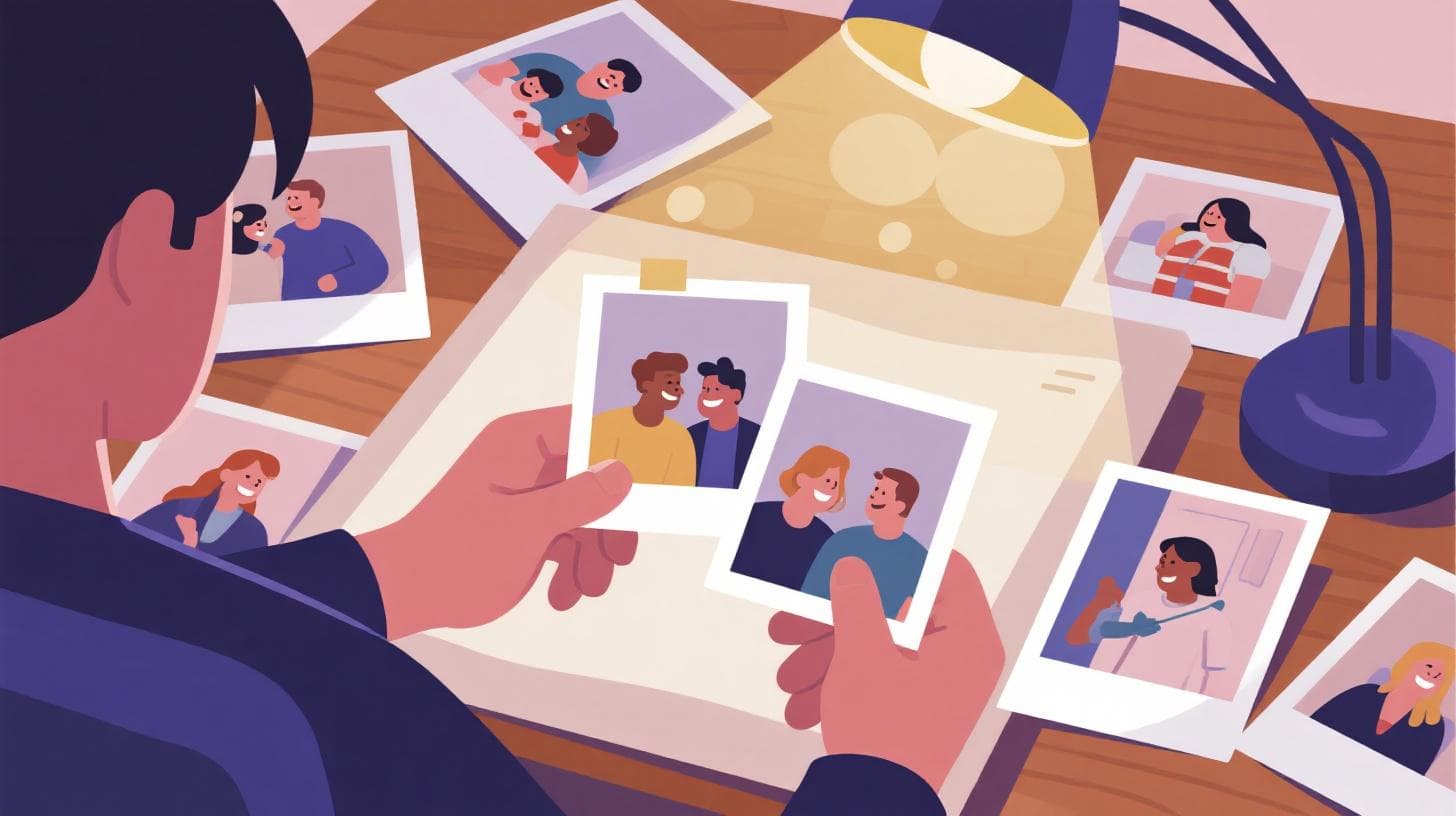
You took 47 photos of your friend blowing out birthday candles. Now you're staring at a grid of nearly identical shots, flipping back and forth between two that look almost the same, convinced you'll pick the wrong one. Sound familiar?
This is photo decision paralysis, and it affects nearly everyone who owns a camera or smartphone. The more photos we take of a single moment, the harder it becomes to choose the best one. Your eyes start playing tricks on you. You second-guess yourself. Eventually, you either pick one at random, give up entirely, or just keep all of them (adding to an already overflowing photo library).
But here's the good news: there are clear, repeatable strategies for choosing between similar photos without losing your mind. And when your own eyes get tired, tools like Photopicker can analyze your photos across quality, sharpness, composition, and more to surface the best shot in seconds. Whether you're sorting through burst mode captures, group shots, or vacation photos, this guide will give you a framework that works every time.
Why Picking Between Similar Photos Feels So Impossibly Hard
Let's start with why this problem exists in the first place. It's not a character flaw or a sign that you have bad taste. It's actually a well-documented psychological phenomenon.
Research on choice overload shows that when people face too many similar options, their ability to make confident decisions deteriorates rapidly. A study published in the National Institutes of Health found that an excess of similar choices leads to decision fatigue, lower satisfaction with the eventual choice, and even avoidance of making any decision at all. When you're staring at 15 nearly identical photos of your dog catching a frisbee, your brain is experiencing exactly this kind of overload.
The problem compounds because photos of the same moment share most of the same qualities. The lighting is the same. The background is the same. The subject is (mostly) in the same position. Your brain struggles to find meaningful differences, so it starts fixating on tiny details that may not actually matter, like whether a blade of grass is slightly sharper in one frame versus another.
The Burst Mode Trap
Modern smartphones make this worse by encouraging burst shooting. Hold down the shutter and you'll capture 10 frames per second. That's great for catching a fleeting expression or a fast-moving subject, but it also means you now have dozens of photos that differ by mere milliseconds. The differences between frames are often so subtle that no human eye can reliably rank them without a system.
Group photos create a similar challenge. You take five shots of eight people, and in each one, a different person is blinking, looking away, or mid-sentence. Finding the frame where everyone looks their best requires comparing multiple faces across multiple images simultaneously, which is cognitively exhausting.
Then there's the emotional attachment factor. When photos capture meaningful moments, like a wedding, a child's first steps, or a reunion with a loved one, the stakes feel higher. You don't just want a good photo. You want the photo. That emotional weight makes every comparison feel like it matters more than it does, which only deepens the paralysis.
The core issue is that humans are excellent at judging photos in isolation but terrible at making fine-grained comparisons across large sets of similar images. Our perception drifts. We get tired. We start overthinking. Understanding this is the first step toward solving it, because the solution isn't "try harder." The solution is to use a better system.
A Practical Framework for Comparing Similar Photos
Instead of flipping endlessly between photos hoping the "right" one will reveal itself, try using a structured elimination approach. Think of it like a tournament bracket: you're narrowing down candidates round by round, using specific criteria at each stage.
Round 1: Eliminate Technical Failures
Before you even think about which photo "feels" best, remove the ones with obvious technical problems. Go through your similar shots and delete or reject any that have:
Motion blur on the subject. A slightly soft face or blurry hand is an immediate disqualifier, no matter how good the expression is.
Missed focus. If the camera focused on the background instead of the subject, that frame is out.
Bad exposure. Blown-out highlights (pure white areas with no detail) or crushed shadows (pure black areas) that lose important information.
Closed eyes or awkward mid-expressions. In group shots especially, quickly scan every face. If anyone's eyes are closed or their mouth is in an unflattering mid-word position, move on.
This first pass should eliminate 30 to 50 percent of your similar shots. You're not making aesthetic judgments yet. You're just removing the photos that fail on basic technical grounds.
Round 2: Compare Composition and Framing
With the technical failures gone, look at what's left and compare the composition. Even in a burst sequence, subtle differences in timing create different compositions:
Subject position. Did the subject move slightly between frames? Is their body language more dynamic or natural in one versus another?
Background elements. Did someone walk into the background of one frame? Is there a distracting object that appears in some shots but not others?
Cropping and balance. Sometimes a slight camera shift between frames puts the subject in a more pleasing position relative to the edges of the frame.
At this stage, you should be down to two or three strong candidates.
Round 3: The Expression and Emotion Test
This is where you stop analyzing and start feeling . Look at each remaining photo and ask yourself one question: which one captures the emotion of the moment best?
Forget about whether one is fractionally sharper. Forget about the background. Which photo makes you feel something when you look at it? The genuine laugh beats the posed smile. The candid mid-conversation glance beats the stiff "everyone look at the camera" shot.
If you still can't decide between two photos after this step, here's a trick that works surprisingly well: shrink them down to thumbnail size. When you view photos as small thumbnails, the fine details disappear, and you're left with the overall impression, the mood, the energy, the composition at a glance. The one that still looks compelling at thumbnail size is usually the stronger photo.
This three-round framework turns an overwhelming comparison into a manageable process. And if you want to understand exactly what qualities make one photo technically stronger than another , it helps to know how professionals and AI systems evaluate sharpness, exposure, and aesthetics.
When to Let AI Do the Comparing For You
The framework above works well when you're choosing between a handful of similar shots. But what happens when you have hundreds of photos from an entire event, with clusters of similar images throughout? Going through a three-round elimination for every group of similar photos at a birthday party, a vacation, or a wedding can take hours.
This is where AI photo scoring becomes genuinely useful, not as a replacement for your judgment, but as a first-pass filter that does the tedious technical comparison for you.
Here's how it works in practice. You upload a batch of photos, and the AI evaluates every single image across multiple dimensions: sharpness, exposure, composition, aesthetic appeal, and overall quality. Each photo gets a score, and similar photos are grouped together. Within each group, the AI identifies the strongest image, the one with the best combination of technical quality and visual appeal.
Photopicker does exactly this. You drag in your photos (up to 500 at a time on the free tier), and the AI scores them, detects duplicates and near-duplicates using perceptual hashing, and ranks everything into tiers. Your S-tier photos are the top 10 percent. A-tier is the top 30 percent. And so on. Instead of comparing 47 birthday candle photos yourself, you get a ranked list with the best one highlighted.
The real power is in the duplicate clustering. When you take a burst of 12 frames, the AI recognizes those as near-duplicates, compares them on technical merit, and picks a winner from each cluster. You don't have to zoom in on each one checking for micro-blur. The algorithm handles pixel-level comparisons that human eyes simply can't do reliably, especially after you've been staring at photos for 20 minutes and your visual perception has started to drift.
When to Trust AI Scores vs. Your Own Eyes
AI is excellent at technical evaluation. It will reliably identify the sharpest, best-exposed, most well-composed frame from a set of similar options. It won't miss the subtle focus shift that makes one frame slightly softer than another. It won't get tired after comparing the 50th pair of photos.
But AI doesn't understand personal context the way you do. It might rank a technically imperfect photo lower even if it captured a fleeting expression that means the world to you. The best workflow combines both: let AI handle the technical elimination (rounds 1 and 2 from our framework), then make your final emotional choice from the top candidates it surfaces.
For large-scale projects like choosing photos for a photo book , this hybrid approach can save hours. The AI narrows thousands of photos down to the best few hundred, and you spend your time on the fun part: picking the shots that tell your story. If you're working through big batches regularly, Photopicker's Starter and Pro plans let you download your ranked sets and access full scoring breakdowns for every photo.
Breaking the "What If" Cycle and Actually Committing
Even with a framework and AI assistance, some people still struggle with the final step: committing to a choice. There's a nagging voice that says, "But what if the other one was better?" This is the last boss of photo decision paralysis, and it requires a mindset shift more than a technical solution.
The 90% Rule
Here's a principle that will change how you select photos forever: if a photo is 90% of what you want, pick it and move on. The difference between your top two candidates is almost never visible to anyone but you. Your friends, your family, your social media followers, they will never see both versions. They'll see the one you chose, and they'll think it looks great.
Perfectionism is the enemy of a curated photo library. The person who spends 30 minutes choosing between two nearly identical sunset photos and the person who picks one in 10 seconds end up with the same result: one sunset photo in their album. The only difference is that one of them wasted 29 minutes and 50 seconds.
Set Time Limits
Give yourself a hard time limit for photo selection. For a batch of 100 similar photos, allow yourself 15 minutes total. For a single group of 5 to 10 similar shots, spend no more than 60 seconds. A timer creates healthy pressure that forces you to trust your instincts rather than overthinking.
If you find the timer stressful, remember that you're not deleting the other photos permanently (unless you choose to). You're selecting a favorite. The others can live in your archive. Reframing the task from "delete the losers" to "highlight the winner" makes the decision feel lower stakes.
The "Show Someone Else" Trick
When you're truly stuck between two photos, show them to someone who wasn't there when they were taken. Fresh eyes see things differently. They'll usually point to one immediately and say, "That one," because they're not bogged down by the memory of the moment or the micro-comparisons you've been running. Their gut reaction is often the right call.
Alternatively, you can use this technique digitally. Post both options in a group chat and ask, "Which one?" You'll have your answer in minutes, and the crowd's opinion will often align with whichever photo is technically and emotionally stronger.
Build a Selection Habit
The best way to beat photo decision paralysis long-term is to make selection a regular habit, not a massive annual project. After every event or outing, spend 5 to 10 minutes culling your similar shots while the memory is fresh. When you remember the moment clearly, choosing between similar photos is dramatically easier because you know exactly which expression or gesture you're looking for.
If you let photos pile up for months before sorting them, you lose that contextual memory, and every similar set becomes a puzzle without a clear answer. Regular curation keeps your library manageable and your decision-making muscles sharp.
The combination of a structured comparison framework, AI-powered technical analysis, and the confidence to commit to a choice will transform how you handle similar photos. You'll spend less time agonizing and more time actually enjoying the photos you've taken. And the next time you're staring at 47 birthday candle shots, you'll know exactly what to do.
Ready to stop second-guessing every photo choice? Upload your photos to Photopicker and let AI surface your best shots in seconds, so you can spend your time on what actually matters: remembering the moment.