How to Pick the Best Dating Profile Photos Using AI
Your dating profile photo does more work than your bio, your witty opener, or your list of hobbies combined. In the time it takes someone to swipe, your photo has already made the pitch. And yet, most people choose their dating photos the worst possible way: they ask a friend, stare at their camera roll for twenty minutes, and pick whatever "feels right."
The problem? You're terrible at judging your own photos. Everyone is. You fixate on details nobody else notices, skip over shots that actually look great, and lean toward the selfie where your hair looked good even though the lighting was awful. Research published in Frontiers in Communication confirms that photo quality factors like sharpness, richness, and composition directly influence dating outcomes , meaning a technically strong photo genuinely gets more matches than a blurry one with a great smile.
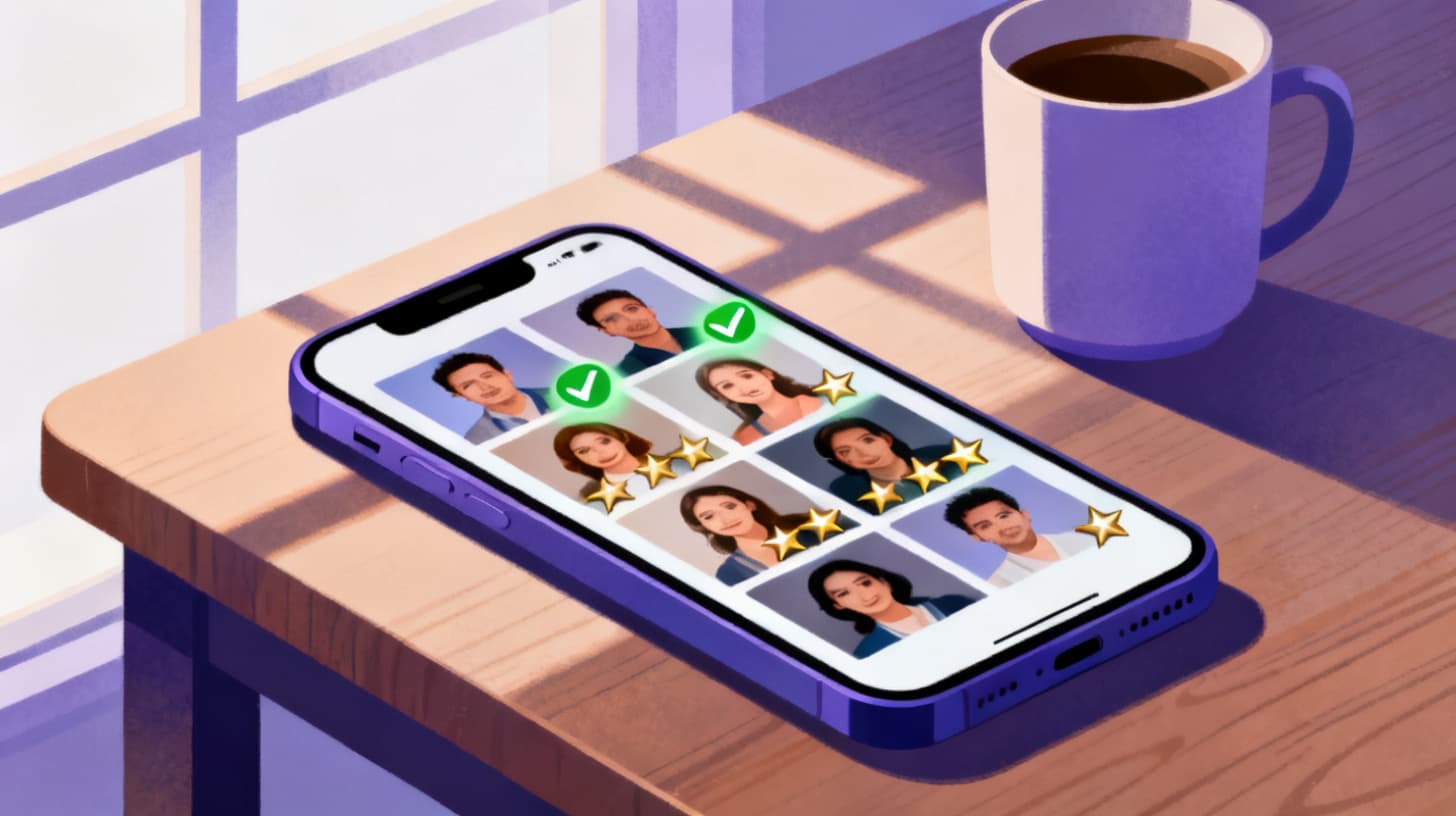
So what if you could remove the guesswork entirely? AI photo scoring tools analyze your images across measurable dimensions like composition, lighting, sharpness, and aesthetic appeal, then rank them from best to worst. No opinions. No bias. Just data. Photopicker lets you upload your dating photo candidates and get objective AI scores for free, without even creating an account. Drag in your top contenders, and within minutes you'll know which shots are genuinely your strongest.
This guide walks you through the full process: understanding what actually makes a dating photo work, preparing your best candidates, using AI scoring to make the final call, and building a profile lineup that gets results.
What Makes a Dating Photo Actually Work
Before you start ranking anything, it helps to understand what separates a great dating profile photo from a mediocre one. And the answer isn't as subjective as you might think. While personal taste plays a role in attraction, the technical and compositional quality of a photo has a measurable impact on whether someone pauses to look or keeps scrolling.
Think about it from the viewer's perspective. They're looking at dozens, maybe hundreds, of profiles. The photos that stand out share a few consistent traits, and none of them require you to be a model.
Sharpness and Image Quality
This is the single easiest thing to get right, and the most common thing people get wrong. Blurry photos, grainy low-light shots, and over-compressed images from screenshots all signal low effort. Your face should be in clear focus. The image shouldn't look like it was taken with a phone from five years ago (even if it was, there are ways around that).
Sharpness matters more than you realize because dating apps compress your images further when you upload them. If you start with a photo that's already slightly soft, it'll look noticeably worse after the app processes it. Starting with a crisp, high-resolution original gives you a buffer.
Lighting That Flatters Without Trying Too Hard
Natural light is your best friend. Photos taken outdoors during the morning or late afternoon have softer shadows, warmer tones, and more even exposure across your face. Harsh overhead lighting (think fluorescent office lights or midday sun) creates unflattering shadows under your eyes and nose.
You don't need a professional lighting setup. A window, a cloudy day, or the golden hour before sunset will do the job. The key is avoiding extremes: too dark and your features disappear, too bright and your face washes out.
Composition and Framing
Great dating photos follow a few basic composition principles. Your face should be clearly visible and take up a reasonable portion of the frame. Group photos where you're one of seven people don't work as a lead image. Neither do extreme close-ups that cut off the top of your head.
The best performing dating photos tend to be shot from chest-up or waist-up, with a clean or interesting background that doesn't compete with you for attention. Think coffee shop, park, city street, or simple wall. Not your messy bedroom, not a bathroom mirror.
Aesthetic Appeal and Authenticity
Here's where things get interesting. "Aesthetic appeal" is the overall visual impression of a photo. It's a combination of color harmony, background choice, your expression, your posture, and how all of these elements work together. A candid shot of you laughing at a farmer's market can score higher aesthetically than a stiff posed photo in front of a landmark.
Authenticity also matters. Over-filtered, heavily beautified photos can actually backfire. People want to see you , not a smoothed-out avatar. The goal is a photo that looks natural but happens to be technically excellent.
All of these factors, sharpness, lighting, composition, aesthetics, and exposure, are exactly what AI scoring tools measure. Instead of guessing whether your beach photo or your coffee shop photo is stronger, you can get a numerical breakdown of each one across these dimensions.
Preparing Your Photo Candidates the Smart Way
The quality of your AI scoring results depends entirely on what you feed into the system. Upload three random selfies and you'll get rankings, sure, but they won't be particularly useful. The real value comes from giving the AI a diverse, thoughtfully selected set of candidates to evaluate.
Here's how to build that candidate pool.
Gather More Than You Think You Need
Start by pulling together 15 to 30 photo candidates. That might sound like a lot, but you're looking for variety across several dimensions: different locations, different outfits, different lighting conditions, different expressions, and different framings. Dig through your camera roll, check photos friends have taken of you, look at pictures from events or trips.
The reason for casting a wide net is simple: you're probably overlooking your best photos. People tend to gravitate toward the same three or four shots they've already used, ignoring dozens of potentially stronger options buried in their library. A photo you dismissed because your hair was slightly different might actually have better lighting, sharper focus, and a more genuine expression than your go-to selfie.
Eliminate Obvious Duds First
Before uploading, do a quick manual pass to remove anything that's clearly not going to work: photos where you're barely visible, group shots where you can't crop without destroying quality, screenshots, memes, or anything that's obviously blurry. This saves processing time and keeps your results focused on real contenders.
If you have a lot of similar selfies taken in the same spot (we all do), you don't need to manually compare them side by side. Photopicker's duplicate photo finder uses AI-powered perceptual hashing to cluster near-identical photos together and automatically surface the sharpest version from each group. Instead of squinting at twelve nearly identical bathroom mirror selfies, you'll get the one that's technically strongest.
Think About Your Full Profile Lineup
Most dating apps let you upload 6 to 9 photos. Your goal isn't to find one amazing photo. It's to build a complete lineup that tells a story about who you are. That means your candidate pool should include:
A clear headshot or portrait (your lead photo, the one people see first)
A full-body or three-quarter shot (gives context about your build and style)
An activity or hobby photo (shows personality beyond your face)
A social photo (you with friends, cropped to keep you as the focus)
A travel or outdoor photo (interesting background, natural lighting)
A dressed-up photo (shows you clean up well for dates)
When you upload your candidates for scoring, having variety means the AI can help you pick the strongest option in each category, not just your best selfie repeated six times.
Upload and Let the AI Do Its Thing
Once your candidate pool is ready, drag your photos into Photopicker and let the scoring run. The system evaluates each image across quality, aesthetics, composition, sharpness, and exposure, then produces a composite score and assigns each photo to a tier. S-tier photos (top 10%) are your headliners. A-tier (top 30%) are strong supporting options. B-tier and below are photos you should probably skip unless you have a specific reason to keep them.
The beauty of this approach is that it removes the emotional attachment you have to certain photos. Maybe you love that vacation shot because of the memory, but the AI might flag it as slightly overexposed with a busy background. Meanwhile, a casual photo you never considered might score significantly higher because the lighting, focus, and composition are all dialed in.
Building Your Profile With AI-Ranked Results
You've scored your photos. Now what? Having objective rankings is powerful, but translating those rankings into a compelling dating profile takes a bit of strategy. Here's how to use your results to maximum effect.
Lead With Your Highest-Scoring Portrait
Your first photo is the only one that matters for the initial swipe decision. It needs to be your absolute best, and "best" means the highest composite score among your headshots and portraits. This should be a photo where your face is clearly visible, the lighting is flattering, the background isn't distracting, and you look approachable.
Check the score breakdown for your top candidates. If two photos have similar overall scores but one ranks much higher on sharpness and the other on aesthetics, lean toward sharpness for your lead photo. A tack-sharp image with good (not great) aesthetics outperforms a slightly soft image with beautiful color grading. People notice blur immediately, even subconsciously.
If you've been considering professional headshots for your profile, the same principles apply. Photopicker's actor headshot scoring analyzes expression, lighting, and composition for portrait-style photos, which is exactly the type of evaluation that matters for a dating lead photo.
Fill the Supporting Slots Strategically
After your lead photo, arrange the rest of your lineup to create variety while maintaining quality. A good rule of thumb:
Slot 1: Best headshot/portrait (S-tier or high A-tier)
Slot 2: Best full-body or activity photo (A-tier or above)
Slot 3: Best social or travel photo (A-tier or above)
Slot 4: Second-best portrait with a different vibe (A-tier)
Slots 5-6: Additional variety photos that scored A-tier or above
Avoid including any B-tier photos unless they show something critically important about you (like a specific hobby that's central to your identity). One weak photo can undermine the impression created by five strong ones. Quality over quantity, always.
Use the Score Breakdown to Fix Weak Spots
One of the most useful features of AI scoring is the per-dimension breakdown. If a photo you love scored well on aesthetics and composition but poorly on sharpness, that's actionable information. Maybe you can find a similar photo from the same day that's sharper. Or maybe you know to prioritize sharpness the next time you take photos in that setting.
Similarly, if your top-scoring photos all have the same background or similar framing, that tells you your current variety is lacking. You might need to schedule a quick photo session in a different environment to round out your profile.
Look at the patterns in your results:
Do your best photos share similar lighting conditions? Replicate that.
Are your outdoor photos consistently outscoring indoor ones? Lean into that.
Is there a specific expression (smiling, candid, looking away) that scores higher? Notice that.
Are certain outfits or colors producing better aesthetic scores? Wear those.
These patterns become your personal playbook for taking better photos in the future, not just for dating but for any context where your portrait matters.
When to Retake vs. When to Work With What You Have
If your entire batch scores below A-tier, it might be worth taking some new photos with the insights you've gathered. You now know what lighting works, what composition the AI rewards, and what backgrounds produce cleaner scores. Ask a friend to snap some photos of you in good natural light, try a few different expressions, and run the new batch through the scorer.
If you have 3 or more S-tier or high A-tier photos, you're in great shape. Build your profile around those, supplement with your strongest A-tier shots for variety, and you'll have a lineup that's objectively stronger than what most people put together by feel.
For users who want to download their top-ranked photos in full resolution or access the complete ranked set, Photopicker's Starter and Pro plans offer ZIP downloads of your best photos along with advanced features.
Putting It All Together
Choosing dating profile photos doesn't have to be a guessing game. The old approach of asking friends, posting polls on social media, or just going with your gut is unreliable because human judgment about our own faces is inherently biased. We overvalue familiarity. We fixate on flaws nobody else sees. We pick photos based on how we felt in the moment rather than how the image actually looks.
AI scoring sidesteps all of that. It evaluates your photos the way a stranger's eyes would process them: quickly, based on visual quality, not emotional attachment. It tells you which photos are sharp and which are soft. Which compositions draw the eye and which feel cluttered. Which images have that hard-to-define aesthetic pull and which fall flat.
The process itself is straightforward:
Gather a diverse pool of 15 to 30 photo candidates from your camera roll
Clean up by removing obvious duds and letting AI cluster your duplicates
Score your candidates and review the tier assignments and per-dimension breakdowns
Build your profile lineup leading with your highest-scoring portrait and filling slots strategically
Iterate by using score patterns to take better photos in the future
The approach works whether you're setting up a profile for the first time or refreshing one that hasn't been getting the results you want. Fresh photos, scored objectively, arranged with intention. That's a profile that works harder for you.
If you're sitting on a camera roll full of potential dating photos and you're not sure which ones are actually your best, upload them to Photopicker and find out in minutes. It's free, it's anonymous, and it'll give you the clarity that staring at your own face in the mirror never will.
Your next great match might just be a better photo away.